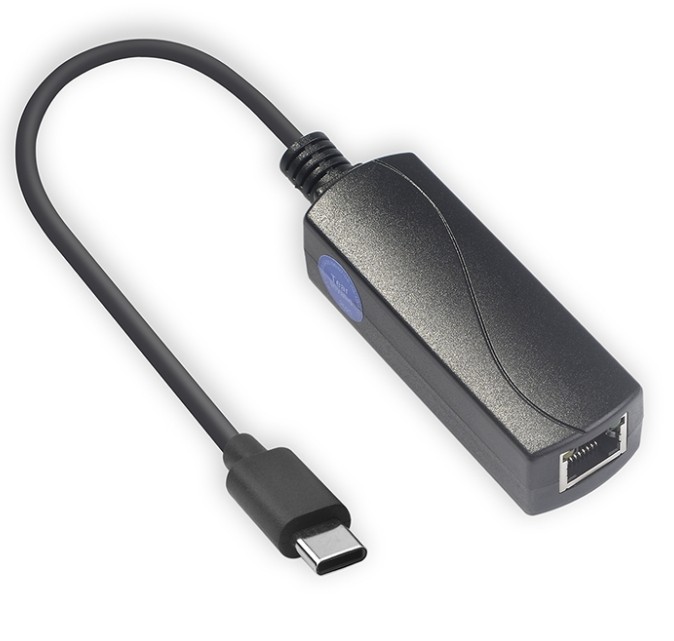
POE to USB-C Driver adapter 10gbps PoE Splitter Ethernet driver
The PoE Splitter is a device that separates the Power over Ethernet (PoE) signal transmitted in the network cable into independent data signals and DC power, specifically designed for terminals that do not support PoE power reception.
Core Functions and Principles
Function: Receives a composite signal (data + approximately 48V high voltage) from a PoE switch or power supply, decouples it into standard RJ45 Ethernet cable (data) and DC interface (e.g., 12V/5V power), enabling non-PoE devices (such as old cameras or regular routers) to draw power remotely.
Principle: Utilizing transformer isolation technology, DC power is extracted and stepped down with stabilization from twisted-pair cables (data pairs of Mode A or idle pairs of Mode B), while ensuring data signals pass through undisturbed to prevent high voltage from damaging downstream equipment.
Key difference: Unlike the "PoE power sourcing equipment/injector," which injects power into the network cable, the former extracts power from the network cable.
Main Types and Specifications
Active Separator: Equipped with a built-in voltage regulation circuit, adjustable output voltage (5V/9V/12V, etc.), supports power negotiation, high safety, and complies with IEEE 802.3af/at standards.
Passive separator: Simple structure, directly reduces voltage by splitting lines, lacks detection and protection mechanisms, requires strict voltage matching, commonly used in low-cost or fixed-specific scenarios.
Common Parameters: Input typically ranges from 44-57V DC; output commonly includes 12V/1A (12W) or 24V; transmission rates are categorized as Fast Ethernet (10/100Mbps) and Gigabit (1000Mbps); some models feature waterproof and lightning-isolated designs (e.g., 1500V isolation voltage).
Typical Application Scenarios and Wiring
Scenario: In the surveillance system, the front-end cameras do not support PoE, but the backend is a PoE switch; wireless APs are deployed in areas without power outlets, and the devices themselves are not PoE-powered; no terminal equipment replacement is required for the old network renovation.
Wiring sequence: PoE source (switch/power supply) → PoE IN port → Data OUT connected to device network port, DC OUT connected to device power port.
Note: Ensure the splitter's output power/voltage matches the terminal device's requirements; use a gigabit splitter in gigabit environments; non-PoE devices must not be directly connected to PoE ports without a splitter
Inquiry
Product
CATALOGUE
 sales
sales