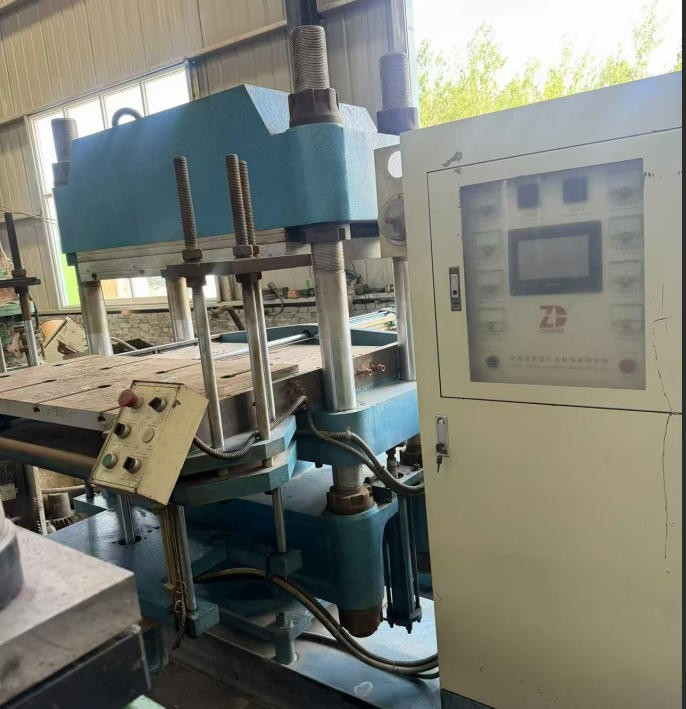
Used Hydraulic Vulcanizing Press machine
Product brief introduction
Equipped with a PLC-based touch screen controller and human–machine interface, this unit enables adjustment of parameters including pressure, heat, timing, and exhaust frequency. It also provides live monitoring of the vulcanization procedure. All operations are executed automatically, giving the machine a streamlined design while maintaining high efficiency and smart functionality.
Platen Press Technical Data
CF-300B CF-400B CF-500B Remarks
Capacity 30T 30T 30T Working pressure /working area/number of floors/cooling and heating plates can be customized according to customer requirements
Working Area 300mm*300mm 400mm*400mm 500mm*500mm
Number of Floors Two floors Two floors Two floors
Cooling and
Heating Plate One for heating
One for cooling One for heating
One for cooling One for heating
One for cooling
Total Power 11kw 15kw 20kw
Weight 750kg 950kg 1200kg
Product Superiority
1. Heating plate: Made of imported high temperature resistant steel, the surface is treated with deep carbonization, hard chrome plating and other processes, with the characteristics of fast heat transfer, corrosion resistance, high hardness, no deformation, etc. Built-in heater and temperature sensor on the back, high power, fast heating, sensitive and uniform temperature measurement, small temperature error range.
2. Cold conduction plate: Aluminum material, anodized surface, corrosion-resistant, fast heat conduction.
3. Guide columns: Four hardened and precisely positioned columns and hydraulic cylinders, supported by a thick steel plate base of the entire control box, the hydraulic platform, on the columns with self-lubricating bronze bearings, guide sliding, lifting and lowering smooth and noiseless; the top and rear of the tablet press are surrounded by heavy steel to provide additional safety protection for the operator; the upper layer is steel plate - with inserted thermocouples in the middle near the surface.
Operating Principle
The raw materials are placed in the mold, the rubber is shaped under rated pressure and temperature, and the product reaches the melting point after a certain period of time, thus obtaining a product with certain physical properties.
Application
Mainly used in rubber and its products, plastic and its products, polyolefins, PVC, films, coils, profiles production and polymer blending, pigments, masterbatches, stabilizers, stabilizers and other industries. Its main purpose is to test the changes and comparisons of the physical properties of raw materials after molding. Such as: color dispersion, light transmittance, glossiness of the material surface, whether there are black spots, its strength, plasticity, hardness after adding auxiliary materials, etc.
It is suitable for factories to inspect the physical properties of suppliers' raw materials, compare similar products, and develop new products by the R&D departments of colleges and universities. It can be used as a reference for factories before mass production.
Typical applications:
1. Detection of gel (fish eyes), black spots, stains, etc. of raw materials
2. Pressing and sample preparation of raw materials
3. Physical property testing
4. Material research and development
Inquiry
Product
CATALOGUE
 sales
sales