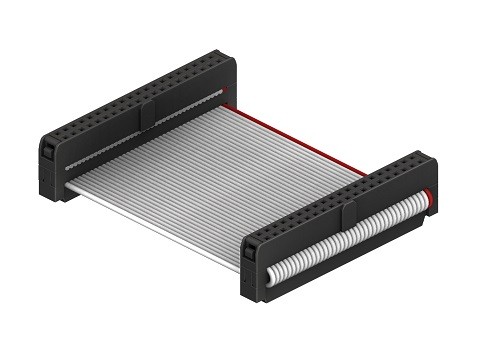
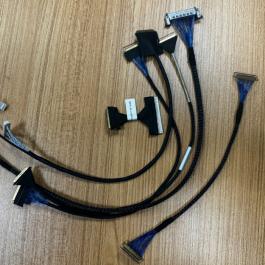
OEM IDC 2.00mm flat ribbon cable
2.00mm IDC Cable Assembly IDC Flat Cable
Flat Cable Wire for Flat Ribbon Cable Assemblies
Flat cable wires are used in flat ribbon cable assemblies because of their unique physical properties and design. The flat shape of the cable allows for the efficient use of space and makes it easier to route the cable in tight spaces. Additionally, the flat shape helps to reduce crosstalk between adjacent wires, which can be a problem in traditional round cables where wires are tightly bundled together.
The design of flat cable wires is such that they have a very low profile, meaning that they are very thin and can be easily folded or bent without damaging the cable. This is important in applications where space is at a premium, such as in electronic devices or computer systems.
Flat cable wires are also known for their high flexibility, which allows them to be bent and twisted without losing their integrity. This flexibility makes them ideal for applications where the cable needs to be moved or adjusted frequently.
How to Make Flat Ribbon Cables?
Cut the wires: Start by cutting the individual wires to the desired length. Use a wire cutter or scissors to ensure clean cuts.
Arrange the wires: Once the wires are cut to length, arrange them side by side in the order you want them to appear in the cable. Make sure they are straight and parallel.
Add a connector: If you need a connector on one or both ends of the cable, attach them now. There are several types of connectors available, including IDC connectors and crimp-on connectors.
Attach the wires: Use a ribbon cable crimping tool to attach the wires to the connector. The tool will ensure that the wires are correctly aligned and securely attached to the connector.
Insulate the cable: Once the wires are attached to the connector, you can add insulation to the cable if needed. This will protect the wires from damage and help to prevent interference.
Test the cable: Finally, test the cable to make sure it is working correctly. Use a multimeter or other testing equipment to check for continuity and proper wiring.
The Advantages of Flat Ribbon Cable Assemblies
Saves Space: Flat ribbon cables have a higher packing density than ordinary round cables. Therefore, in much new aviation and other equipment, the flat ribbon cable is used to make it more applicable to equipment with narrow space.
Light Weight: Due to the stacking of flat ribbon cables and the simplification of fixtures and supports, the weight in this respect is lighter than that of round cables. In addition, the conductor made into a pin-type connector is much lighter than the round connector.
More Flexible: Flat cables have a larger bending amplitude. So in some cases where the cable is often bent, the flat cable can be applied to avoid breaking due to frequent bending.
More Reliable: The use of flat conductor ribbon cables for interconnection ties improves reliability in some ranges. The high tensile strength of the insulation and the planar structure provides for uniform stresses on the cable, improving resistance to operating and dynamic workload. The advantages are even more significant when using smaller conductor sizes. Flat cables have fast heat dissipation so they can reduce operating temperatures and have proven to be reliable in many applications.
Small Size: The high tensile strength of the insulation and the flat structure make the cable evenly stressed and improve the ability to withstand operation and dynamic workloads. When using smaller-sized conductors, the termination of the flat cable is easy to mechanize, simple, and reliable.
Lower Costs: The material costs, design, and development costs, manufacturing costs, and installation costs play an important role in reducing costs.
Stronger: Due to the uniform stress distribution and the increased strength of the flat cable, the structural strength is improved, so the cross-sectional area of the conductor can be reduced to the size required for the current capacity. The conductors are easy to separate and can be routed in the circuit.
Inquiry
Product
CATALOGUE
 sales
sales